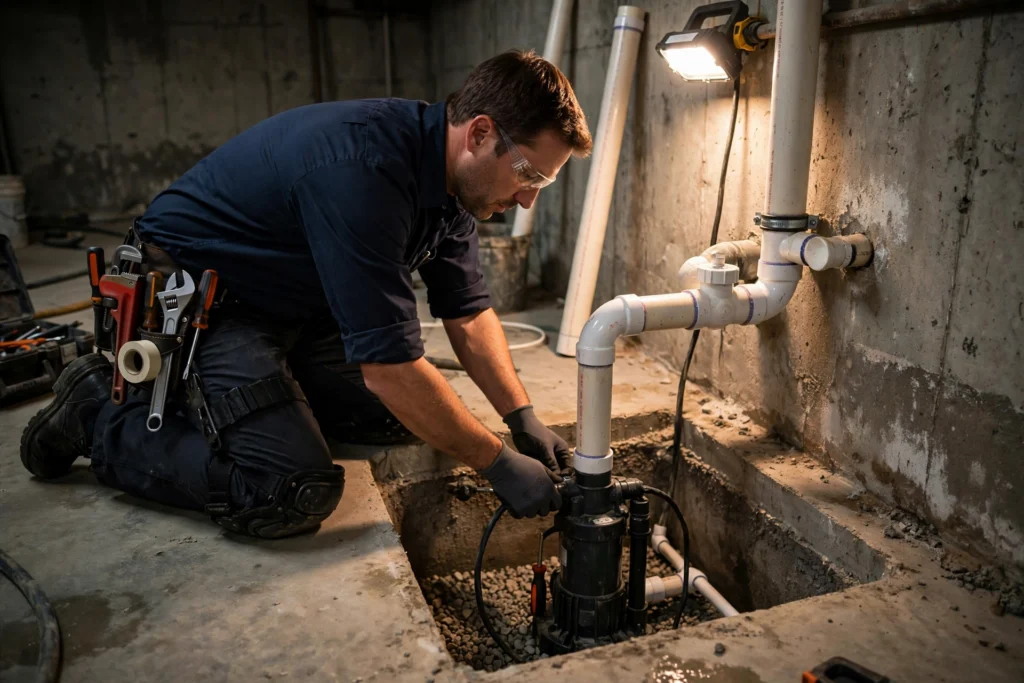
Every spring, the same thing happens across Indianapolis: three days of rain, saturated clay soil pushing groundwater toward basements, and sump pumps that sat idle since November failing at exactly the moment they’re needed. We repair and replace sump pumps, install battery and water-powered backups, and fix the check valves and discharge lines that cause most “the pump is running but the pit is still full” calls. Same-day service, and 24/7 during storms with no overtime fee.
Call (317) 676-7903 or book online.
Why Indianapolis basements flood
Marion County and the surrounding counties sit on dense clay. Clay absorbs water slowly and holds it, so after a heavy rain the ground around a foundation stays saturated for days and hydrostatic pressure pushes water toward the lowest point: your basement floor and the footing drains that feed the sump pit. A pump in a typical Indianapolis basement may cycle hundreds of times during a March storm.
Add the second local problem: spring storms knock out power. A pump without a backup stops the moment the lights go out, which is usually the moment the rain is heaviest.
Signs your sump pump needs attention
- It runs constantly, or cycles on and off every few seconds (a stuck float or failed check valve).
- It makes grinding, rattling or humming noises, or vibrates hard when it runs.
- Water in the pit isn’t dropping even though the pump is running (clogged intake, broken impeller, or frozen/blocked discharge line).
- It’s more than 7 to 10 years old. Most residential pumps don’t make it much past that.
- Rust, scale or a smell from the pit.
- Visible water lines or damp patches on the basement walls after rain.
- You can’t remember the last time it was tested.
Test it today: pour a bucket of water into the pit. The float should rise, the pump should kick on, and the water should drop quickly and stop with a solid click as the check valve closes. If any part of that doesn’t happen, call.
Sump pump services
Sump pump repair
Stuck or waterlogged floats, failed switches, clogged intake screens, broken impellers, failed check valves and split discharge lines. Many repairs are done on the first visit; if the motor itself has failed, replacement is almost always the better value.
Sump pump replacement
We install submersible pumps sized to the inflow your pit actually sees, typically 1/3 to 1/2 horsepower for an Indianapolis home, with a cast iron housing for heat dissipation and a vertical float switch that won’t hang up on the pit wall. New check valve and discharge connections are included. Typical cost $400 to $1,200 installed.
Battery backup systems
A battery backup pump sits alongside the primary pump and takes over when the power fails or the primary can’t keep up. A good deep-cycle battery runs the backup for several hours of heavy cycling, which covers most Indianapolis storm outages. Typical cost $800 to $2,000 installed, including the battery and charger.
Water-powered backup pumps
For homes on city water, a water-powered backup uses municipal pressure to pump out the pit, no battery required, so it runs indefinitely during an outage. It uses city water while it runs, so it’s best as a secondary backup or where battery maintenance is a concern.
New sump pit and drain tile installation
For basements that get water but have no pit, or finished basements being protected for the first time, we cut the pit, connect the footing drains and install the pump and discharge line, with a sealed lid for radon and humidity control.
Sewage ejector pumps
Basement bathrooms and laundry rooms below the sewer line rely on an ejector pump to lift waste to the main. We repair and replace ejector pumps, alarms and check valves. See also sewer line repair.
Discharge lines: the part everyone forgets
The pipe that carries water from the pump out of the house fails in two Indianapolis-specific ways. In winter, a discharge line that runs across the lawn or ends near the foundation freezes solid, and the pump runs against a block of ice until it burns out. In spring, a line that dumps water within a few feet of the house just recycles it back into the footing drains. We extend, bury, add freeze-protected outlets and re-route discharge lines so the water actually leaves.
What sump pump work costs in Indianapolis
| Service | Typical Indianapolis range |
|---|---|
| Diagnosis / service call (credited toward repair) | $60 – $150 |
| Sump pump repair (switch, float, check valve) | $150 – $400 |
| Sump pump replacement, installed | $400 – $1,200 |
| Battery backup system, installed | $800 – $2,000 |
| Water-powered backup, installed | $700 – $1,500 |
| New pit and pump installation | $1,500 – $3,500 |
| Discharge line repair / extension | $200 – $800 |
| Storm emergency surcharge | $0 |
Ranges are typical for Indianapolis; your written quote is exact. See the Indianapolis plumbing cost guide.
Sump pump service across the metro
All of Indianapolis plus Carmel, Fishers, Zionsville, Avon, Plainfield and Greenwood. Suburban homes with finished basements in Carmel and Fishers are our most common backup-system installs.
Frequently asked questions
How much does a new sump pump cost in Indianapolis?
A replacement submersible pump typically costs $400 to $1,200 installed in Indianapolis, depending on horsepower and whether the check valve and discharge fittings need replacing. Adding a battery backup runs $800 to $2,000. We quote in writing before starting.
My sump pump stopped during a storm. Can you come now?
Yes. Storm failures are handled 24/7 with no overtime fee. While you wait, confirm the pump is plugged in and the breaker is on, and lift the float by hand to see if it runs. If it doesn’t, we’ll replace it on the spot.
How often should a sump pump be replaced?
Most residential pumps last 7 to 10 years. In an Indianapolis basement that cycles heavily every spring, plan on replacing closer to 7. If yours is past that age and you can’t remember the last test, replace it before March rather than after a flood.
Do I need a battery backup?
If your basement is finished, if you’ve had water before, or if you lose power in storms, yes. The primary pump is useless during an outage, and outages in Indianapolis cluster during the exact storms that fill the pit. A battery backup is the cheapest flood insurance you can buy.
Why does my sump pump run constantly?
Usually a stuck float, a failed check valve letting water fall back into the pit after every cycle, or a pump that’s undersized for the inflow. Occasionally a broken underground water line or a high water table is feeding the pit continuously. We diagnose which on the first visit.
Why is my pump running but the water isn’t going down?
The discharge line is blocked, frozen or disconnected, the check valve is installed backward or stuck, or the impeller is broken. In winter a frozen discharge is the most common cause in Indianapolis. Shut the pump off so it doesn’t burn out and call us.
Can a sump pump discharge into the sewer?
No. Indianapolis prohibits connecting sump pumps to the sanitary sewer because the volume overwhelms the system during storms. Discharge has to go outside, away from the foundation, and we install it that way.
The best time to think about your sump pump is in February, not in the middle of a March thunderstorm. Call (317) 676-7903 for a test, a repair or a backup system, and keep your Indianapolis basement dry this spring.